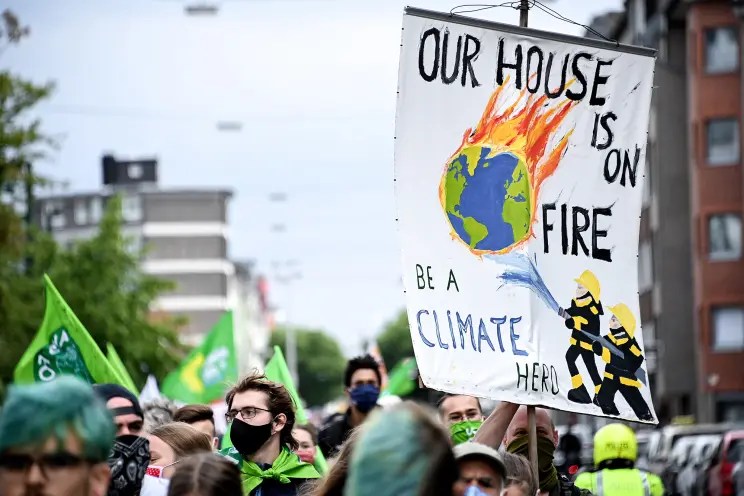
In 1995, the United Nations declared they had detected “human influence” on global temperatures which are “effectively irreversible”. Since then, 99.966% of scientists have agreed that burning fossil fuels has disrupted the Earth’s climate, leading to adopting transnational arrangements such as the Kyoto Protocol, back boning future IPCC reports, and increasing the momentum of the UNFCCC.
Now, let me clarify, I am not in denial about any change to our climate. Nor do I deny that there is a vast human influence within our planet’s changing ecological systems. However, I do not agree that our planet is warming to a degree that we cannot inhabit and that we must therefore cut our carbon dioxide to solve this “crisis”.
For instance, by historical standards, over periods of millions of years, we are, for lack of a better word, in a carbon dioxide drought. I know that might sound like some right-wing conspiracy theory, but this data is taken straight from NASA and NERC.
When we look at CO2 levels from 500 million years ago, we currently sit at one of the lowest points in our planet’s lifespan.
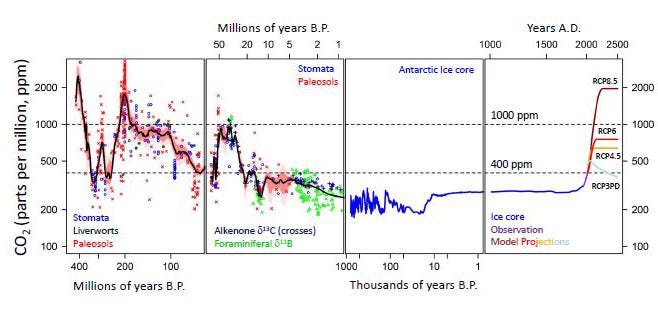
But, if we rely on the evidence-collection methods of the United Nations, we receive a completely different story. For example, you will see a very steep increase in temperature and carbon dioxide levels in the past century, suggesting that the Earth is indeed in a CO2 crisis.
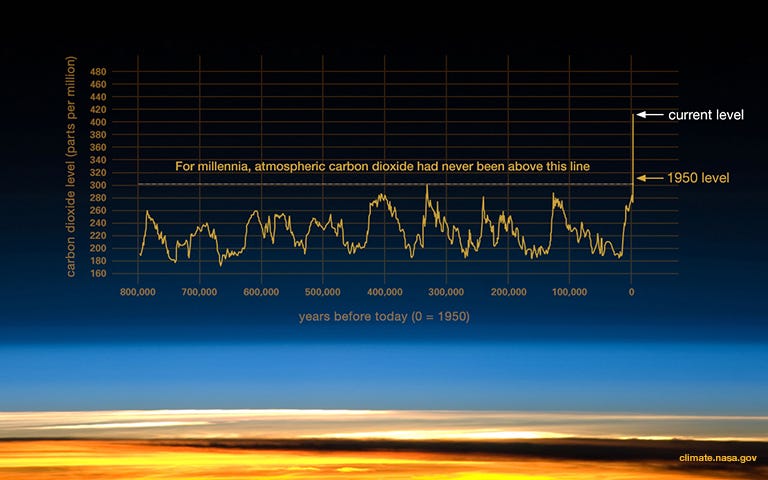
Further paleoclimatic data suggests that Earth’s climate has always been dynamic, fluctuating widely over geological scales. For instance, during the Cambrian period, around 500 million years ago, CO2 levels were estimated to be between 4,000 and 7,000 parts per million (ppm), compared to current levels of 400 ppm. Not only was CO2 ppm at least 10x more, but the temperature was far hotter, with tropics averaging 30℃, compared to the current 16℃.
Also, considering 500 million years is only the most recent 16% of the Earth’s lifetime, it seems bewildering to me to base a “consensus” on data only from the past few hundred years.
Another example comes from the Mesozoic era, particularly the Cretaceous period (140 million years ago), where CO2 was similarly high, and dinosaurs roamed lush, warm forests, across every one of Earth’s ecosystems, including polar regions. Back then, ice caps did not exist, and sea levels were hundreds of feet higher than today. The Earth thrived in a greenhouse state, inhabiting billions of lifeforms.
So, when comparing these ancient climates to the one of today, which is relatively cooler and lower in CO2, it becomes clear that the Earth has undergone many extreme changes whilst containing life forms. This raises an important question about the relative significance human influence has on the ecosystem’s changes.
By my view, the influx of CO2 from human influence into the atmosphere is a net ecological good. This is because, in the past 20 years, the planet has greened by an area factor of 20%, primarily taking place in semi-arid areas. In fact, it took place in the same areas that we were told would face desertification if fossil fuel production did not halt, suggesting these dystopian propositions were not only wrong but wrong in the opposite direction. This is an example of flawed predictions that arise from solely relying on data spanning just a century. To put it in perspective, the evidence collected in 1995 by the United Nations, sparking a consensus on CO2 consequences, represented only 0.0000003% of the Earth’s entire lifespan – a mere blink of an eye in geological terms.
However, the current increase in CO2 and temperature is unprecedented when compared to readily available historical data from the past hundred thousand years. This rapid change poses a significant challenge to existing ecosystems and species, many of which have evolved and adapted to much lower CO2 levels. The speed at which these changes are occurring is unlike anything seen in the Earth’s recent history, where natural fluctuations typically occur over much longer timescales. As a result, the current pace of change is so rapid that it risks outpacing the ability of many species and ecosystems to adapt, potentially leading to widespread ecological disruptions.
So, while it is undeniable that human activities have significantly altered the Earth’s climate, it is vital to consider the broader historical context. Although the current situation is concerning, it is by no means an event that warrants a complete reindustrialisation of our society to “cut carbon”. It also does not justify the mass hysteria perpetuated on the general population. In reality, it is an opportunity for humanity to adapt and innovate. For instance, we need to find capabilities for improving energy efficiency, protecting ecosystems, and boosting the output of lower-middle-income countries. By doing so, we can ensure that the Earth remains a habitable planet for future generations of animals and humans alike, whilst enabling societal growth.
For this to occur, world leaders must reassess their approach towards climate change. Instead of focusing solely on reducing carbon emissions, as this has currently had no positive impact, a different approach is needed. This, in my opinion, should include the 12 revisions outlined in the Copenhagen Consensus Centre.
 Vitality Blueprint
Leave a comment