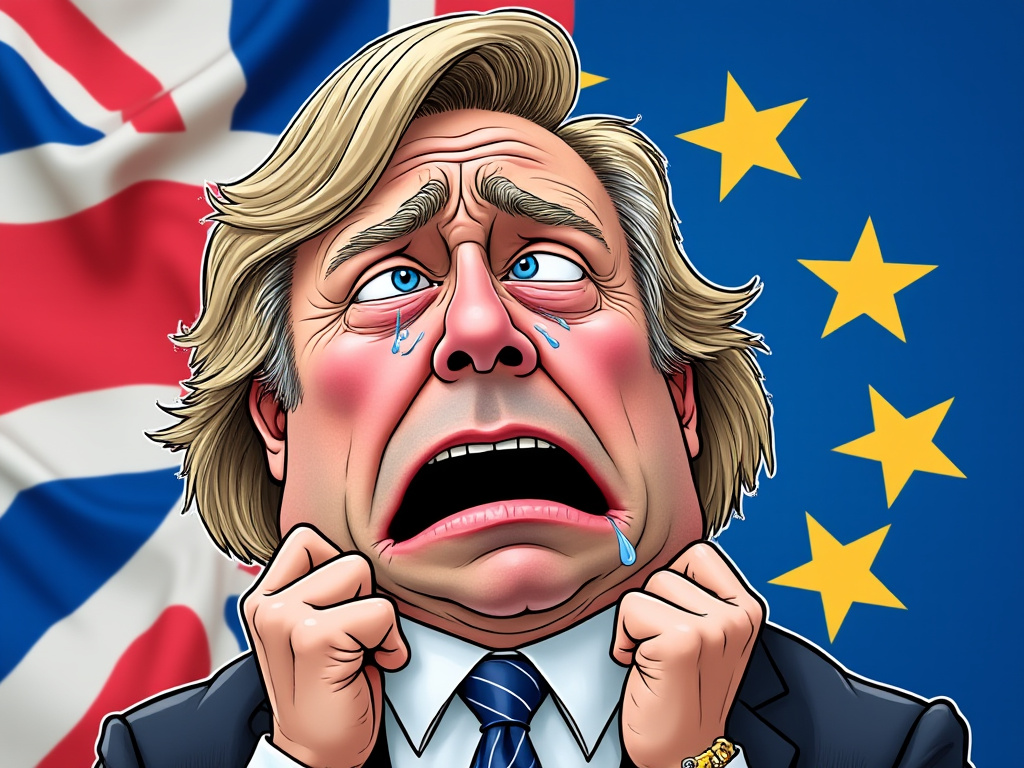
Since the formal departure of the UK from the EU in February 2020, many have called for another referendum, with people expressing regret for voting ‘Leave’ or for not voting at all. This is directly because we have been bombarded with the supposed net negative of Brexit. We’ve been told that our GDP is lagging compared to other Western nations, with net trade being below what it could have been. This article is for those who deny the very existence of benefits from leaving the EU. As with every political decision, it is completely up to the individual whether they believe we received a net positive or negative from this referendum. However, it is completely unserious to deny any positive or negative consequences, no matter what side of the aisle you are on.
To start, let’s mention the supposed minute GDP growth we have had compared to the likes of the G7. Firstly, GDP does not represent growth at all, despite what some media outlets may suggest. GDP, or Gross Domestic Product, is the estimated market value of all goods and services during a specific period. However, it is not the only measure to evaluate an economy’s financial situation; it is only a snapshot of the economic activity of a country. For instance, when we shift the focus to income, regardless of the method by which it is earned, the UK has seen a rise exactly like the EU.
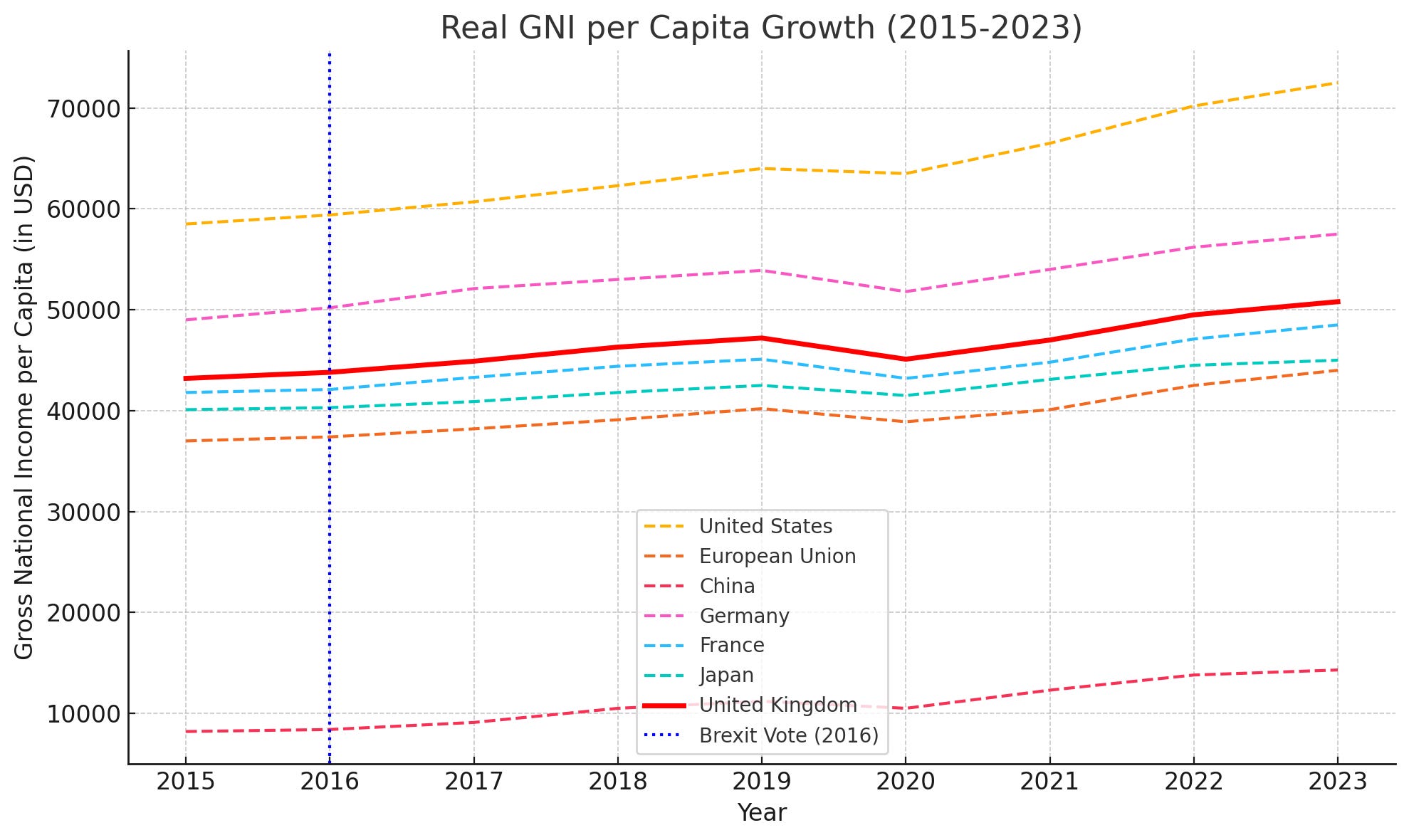
Similar snapshots can be seen in service exports, high-skilled worker immigration, non-EU migration, joining partnerships, and so on. But, as mentioned before, whether Brexit was a net good or bad is completely up to opinion. Giving little snippets into Britain’s economy is no way to display or explain an opinion, especially since the whole referendum started due to regaining sovereignty. So, it is more useful to provide actual policies that explain why I believe Brexit was/will be a net good.
Therefore, in my opinion, the UK is far better off leaving the European Union than staying in it. As someone too young to vote in the referendum, if I could have, I would have voted for Brexit, even with hindsight. Let me tell you why:
Firstly, the UK was a net contributor to the EU, meaning it paid more than it received in return. In fact, the UK was responsible for 12.5% of the annual core budget of the EU. In practical terms, had the UK remained in the EU, its gross contribution to the union would be about €24 billion each year. Of this, the net contribution (after accounting for the EU funding received) would be between €14 and €16 billion annually. By leaving the EU, the UK no longer needs to make these substantial annual payments, meaning the saved taxpayer money can now be redirected towards domestic priorities. It allows the UK government to potentially invest more into national infrastructure, public services, or other beneficial areas, instead of contributing to the broader EU budget.
Secondly, as an EU member state within the Customs Union, 75% of all customs revenue went to the EU budget. As a member of this union, the UK was obligated to share a portion of the customs duties it collected on imports from non-EU countries with the EU. At the time the UK was part of the Customs Union, 80% of the revenue collected from imports went to the budget. This helped fund various EU programmes, projects, and operational costs, meaning the UK government only retained 25% of duties on goods entering the UK. Since leaving, we are not bound by this rule, allowing the UK government to collect 100% of the customs revenue – estimated to be £2-3 billion per year.
Thirdly, in January 2021, the European Union introduced a new policy aimed at reducing plastic waste and encouraging recycling. Under this policy, EU member states were required to pay an annual fee for every kilogram of plastic packaging waste not recycled – set at €0.80 per kg. This initiative was part of the EU’s broader ‘green policy’ goals, particularly its commitments to reach the European Green Deal obligations.
The UK had obligations tied to 2021 when this policy came into force. In that year, it is estimated that the UK produced 2.5 million tonnes of plastic packaging, with 1.4 million tonnes not being recycled. This means the UK had to pay a fine of €1.12 billion to the EU in 2021, which would have been €904 million in 2022, and about €1 billion in 2023. After the referendum, we are no longer obliged to pay a fine to this union.
Another benefit of Brexit is Britain’s ability to trade in Swiss equities. In 2019, the EU prohibited its member states from trading in such stocks to pressure Switzerland to accept the union’s terms on their bilateral relationship. In other words, they used economic coercion to ‘encourage’ the Swiss to accept their terms, which is illegal in the public sphere. But outside of the EU, the UK returned to trading Swiss equities, which has enabled HMRC to make around £8 million per day or about £3 billion in additional tax revenue annually.
An additional advantage is the UK’s replication of EU trade deals. We were told that exiting the EU would ruin our trade with them, but Britain has replicated 40 out of 43 trade deals as part of its exit. Negotiations with the EU and various countries have seen Britain exactly replicate almost all the trade deals, with minimal additional barriers or tariffs, that we had before exiting. The only 3 that are missing include Bosnia, Montenegro, and Algeria. The biggest difference, however, is that we get all the benefits of reduced tariffs, but without the annual membership fee. Not only has this freed up funds for domestic priorities, but it has also allowed our trade to continually grow with minimal challenges.
Furthermore, the UK’s Department for Business and Trade (DBT) has made huge progress in resolving trade barriers, previously not possible while an EU member state. The DBT has so far resolved 193 trade barriers in 79 different countries since the exit. Such government restrictions on the free exchange of goods and services were implemented by the EU when Britain was a paying member. These barriers, therefore, made it difficult for businesses to operate across non-EU borders. As a result of the DBT and political leaders’ efforts, we kept our trade deals with the EU and dissolved 193 barriers. Out of this number, 45 of them had particularly high economic value for UK businesses, with projections to be worth about £5 billion over 5 years (£1bn annually). Therefore, the UK’s departure from the EU allowed them to negotiate trade agreements independently, directly aligning with the regained sovereignty as fought for by the Brexit campaign.
Finally, in 2019, as a member of the EU, the UK was not ranked among the top 10 countries in terms of openness or liberalisation in the services sector according to the Services Trade Restrictiveness Index (STRI). The STRI measures how restrictive a country is in terms of its regulations that affect trade in services, such as legal, financial, and telecommunications. Being outside the top 10 suggests that the UK, like other EU member states, had to adhere to the EU’s broader trade and regulatory policies. But, by 2022, after the exit, the UK’s position on this index had dramatically improved, with it now being placed 2nd, behind only Japan. This substantial shift in ranking is attributed to liberalisations, such as financial service deregulation (MiFID II), easing restrictions on foreign law firms, cross-border data flow, independent trade deals for e-commerce, and less stringent rules on foreign-owned telecom services, all of which were made possible due to Brexit.
In the years since the UK departed from the European Union, the effects of Brexit have caused many debates. Much of Britain expressed regret over their vote to leave or for not voting, citing the perceived economic drawbacks reported by the media. However, there are undeniable benefits that have emerged from Brexit, many of which have been completely overlooked.
While opinion about whether Brexit has resulted in a net positive or negative for the UK will always vary, it is uncritical and disingenuous to ignore the tangible benefits. The UK has regained control over its financial contributions, customs revenues, and trade agreements, with GDP (even as flawed of a statistic as it is) projected to skyrocket over the next 6 years. It has also benefited from increased sovereignty over its laws and regulations, allowing the country to engage in more direct and tailored trade negotiations.
This list is far from comprehensive when talking about the benefits of Brexit. It does not mention how Britain has half of the tariffs on all product lines entering our borders compared to the EU (47% to 27%), lower-salaried workers have improved income and working conditions after the removal of Freedom of Movement, equal application of UK entry rights for both EU and non-EU citizens, a partnership on cancer treatment R&D with BioNTech due to post-Brexit regulatory environment, rollout of a bespoke Subsidy Control Scheme, and equal access to the UK welfare system for all non-UK citizens instead of the EU getting priority.
All these points, although only scratching the surface, clearly illustrate numerous advantages Brexit has afforded the UK and the British people. The newfound control over our sovereignty has enabled specifically tailored policies that better suit domestic interests, not the interests of a transnational union. Ultimately, while Brexit remains a critical topic, these tangible benefits should not be ignored. No person, or news agency, should uncritically examine such a huge political referendum just because of bias. Whether you believe Brexit will cause a net positive or negative (as no one knows the outcome yet), is completely up to you. Just make sure your viewpoint is backed up with policies rather than just forecasted figures or speculative graphs suggesting where Britain could have been.

 Vitality Blueprint
Leave a comment