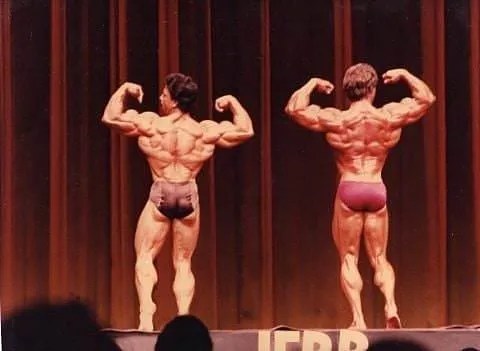
As someone who would consider themselves quite interested in bodybuilding, learning the numerous ways to cultivate and sculpt the human body to portray that of a stereotypical Greek God has become an avid interest of mine.
From the techniques of Hany Rambod (the greatest bodybuilding coach of all time) to the exercise science of Dr Mike Israetel (the human embodiment of a fitness encyclopaedia), I have spent years trying to understand what it takes to become a bodybuilding coach. Whilst I have minimal field experience, meaning I have not yet trained anyone for competition, I have cultivated my own teenage skinny-fat body into something that looks more appealing under professional standards. By no means could I compete next week. However, I do pride myself on my rapid changes and also my ability to edit other people’s bodies to fit their physical standards during our training sessions.
So, my aim here is to take one of the biggest parts of the human body, the back, and tell you how, in my opinion, you should train to make it conceivably larger and more proportionate. I understand this article may not be for everyone, but for me, this side of exercise science does have a way of benefitting everyone, even if at first, you don’t see how.
Most commonly, I get asked, do I need to do heavy deadlifts and bent-over rows to build my back? Well, one of the most ambitious and celebrated bodybuilders throughout history, Jay Cutler, hardly ever did deadlifts, but his back is regarded as one of the best since the sport began. So, what did Jay do? He focused on the primary goal of building a back, the proportional aesthetics. This meant he used a combination of exercises that build the lats, spinal erectors and rhomboids, usually not involving hip hinge movements as they, on average, provide far less stimulation to the targeted muscles. So instead, he focused on horizontal plane pulls and controlled pulldowns where emphasis can be placed on your lats and teres muscles.
Another way to think about it is to do exercises where you have at least three points of contact. This means that to stabilise the body and make sure you use minimal stabiliser muscles, your body should have three separate points of contact with the ground/equipment. For example, imagine a seated cable row. The three points of contact would be your two feet on a platform and your glutes on the bench. Taking this approach minimises stabiliser muscles and allows you to take the time and energy to fully stimulate the targeted area, which in the case of a seated cable row (depending on the handle) would be your lats and rhomboids.
Thirdly, the aim of your aesthetic workouts should be to minimise CNS overload whilst taking the targeted muscle group to failure. In other words, you want to train hard enough to ensure your energy recovers by the time you next train, but to ruin your targeted muscle group so that it takes a few days to repair. This, however, is usually not exercise-dependent. Most of the time, you will get more CNS usage from free weights just from the fact that it uses more stabilising muscles and people tend to go heavier. However, you tend to only do these exercises if the stimulation is actively causing DOMS (delayed onset muscle soreness). Let’s say you do close-stance deadlifts, but by the time you’ve done your three working sets, your CNS is burnt out, but it is your first exercise. If this is the case, then deadlifts are not for you. You are far better off starting with cable work or a three-point-of-contact free-weight exercise to encourage the highest stimulation but the least fatigue.
Simply put, these are the three rules of thumb I live by when curating workout plans for people:
- Heavier does not mean better. Stimulation does not equate to weight on the bar.
- Three points of contact is (usually) king.
- The goal is to build muscle, not destroy the body. Take care of your CNS while training.
As with everything in life, there is no one-size-fits-all theory. The same goes for building a bigger back. One exercise might work for one person, but the same won’t work for another, usually due to genetic differences and enjoyment levels. Personally, I make sure people understand their training goal so they can curate their own “perfect back-building workout”, instead of just giving them exercises. This enables informed decision-making, and the ability to specifically edit their training if need be.
But, if you are interested, and would like a good starting point, this is currently what I do to train my back. Take it if you’d like but understand that it may not work for you.
A) Deficit Bent-Over Row: (Standing on a platform, making sure to fully extend the arms as far as possible. Not going heavy, but going for strict reps, pause at the bottom, 2 seconds eccentric, 12-15 reps).
B) Machine Rows/Cable Row: (3 points of contact, fully extend the rhomboids and rear delts to allow your back to bend forward. This enables the best stretch bias possible for a row).
C) Lat-Pulldown: (Choose your preferred handle. Fully extend at the top, lean slightly back on the way down and bring it to your lower lip. Pause. Slowly extend back up).
D) Assisted Pull-ups: (If you are doing a back/bi workout, you can do underarm. If you are just doing back, use this as a finisher with overhand. Full extension at the bottom, not any of these half reps. Pause. Power on the way up).
The main goal here is to stimulate. Remember that. Your goal is to become more aesthetically pleasing, not to compete in World’s Strongest Man or a marathon. This means your modality should be slow and controlled movements ALWAYS. At no point do you need to be throwing the weight around risking injury (even if it is more fun).
Make sure to always brace, mentally select the muscle you want to activate and locate the movements that allow you to get the best stretch bias for your body. Lastly, choose exercises you enjoy. If you love deadlifts and this exercise is the being of your existence, then go do it as much as you’d like. Individuals who enjoy what they do are far more likely to stick to it.
 Vitality Blueprint
Leave a comment