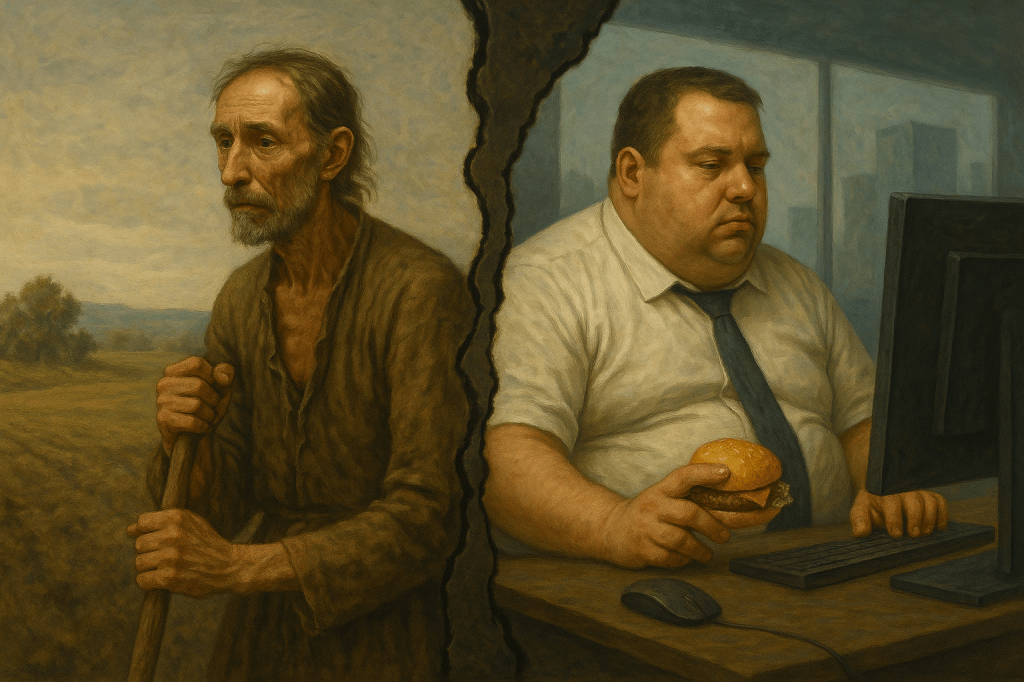
Are we really healthier than our ancestors? At first glance, the answer seems obvious. We live longer, science has conquered numerous fatal infectious diseases, and modern medicine can solve ailments that previously meant certain death. But, if we look deeper into the statistics, the story becomes far more unsettling.
Life expectancy at birth is often cited as evidence for our superior health. In many countries, it hovers around 80. This is, without a doubt, a huge contrast to the alarmingly low 40 years of age that has been touted for decades. Yet much of that difference comes from the reduction in infant and child mortality. Centuries, even decades, ago, a quarter of all infants were lost before their first birthday, and nearly half of all children died before reaching puberty. However, if a child survived past the age of five, their chances of living into their 70s were decent, though still far from the currently recognised average lifespan of 80 years. So, the dramatic leap in life expectancy is as much about surviving childhood as it is about the quality of adulthood.
And what about the quality of that health? Our ancestors rarely suffered from the chronic diseases that plague today’s obesity-ridden society. Their diets, while sometimes lacking in certain nutrients, were entirely natural and unprocessed. Not only this, but their lives were physically demanding, with most people engaged in labour-intensive work. Contrast this with our modern world, where the majority work in offices, struggle to reach 10,000 steps a day, and survive on seed oil-laden, ultra-processed ‘foods’. The rise in chronic disease is no accident, it is a direct consequence of our poor decision-making. Lax food regulation, inadequate education, lack of opportunities, and flawed nutritional research have created an overfed yet malnourished society.
The evidence is clear. Countries with robust food regulations, adequate nutritional education, and active citizens fare better. In Japan, for example, a strict food culture and standards, alongside the enjoyment of physical activity, have kept obesity rates among the lowest in the developed world, even though their rates are also on the rise. Compare this to the United States or United Kingdom, where culture is dominated by leisure and consumerism, and obesity rates are among the highest in the world.
The Netherlands is another example. Their regulated private health system seems to be doing something right. Dutch residents enjoy some of the highest life expectancies and best health outcomes worldwide. Their success cannot be attributed solely to wealth, as surrounding nations, such as the UK, do not experience the same results. Instead, smart policy, active citizens, and a minimal ultra-processed food culture have increased the collective good.
But it doesn’t stop there. Mental health is also in enormous trouble. The epidemic of depression, anxiety, loneliness, and suicide has surged since the late 20th century and reached unprecedented levels. While our ancestors faced war, famine, high mortality, and extreme physical stressors, they did not have access to the comfort of a ruminative mindset. The breakdown of the modern system of pleasure-seeking attention and approval from others-has worsened self-perception, leading to isolation and a cycle of avoiding responsibility. It is no coincidence that countries which spend more time discussing mental health issues tend to report worse mental health outcomes.
The loss of social cohesion is not a trivial matter. The encouragement of individualism, self-reliance, and independence has resulted in men and women spending 50 years of their lives sitting in front of a desk under LEDs for 8+ hours a day. We have traded dangerous manual labour and stay-at-home mothers for an emotionally impoverished, mundane existence where happiness is based on satisfying the whims of our “higher-ups” and the next salary. The traditional roles that once provided a sense of belonging and purpose have given way to a culture that prizes prosocial behaviour and conditional self-worth above all else.
However, work and safety have improved in some ways. Dangerous manual labour, child labour, and workplace accidents were far more common in the past. Today, regulatory standards and technology protect most workers. War, famine, and violence were routine threats for most ancestors but modern societies, especially in high-income countries, are generally safer and more stable. Yet, the pressure to maintain constant connectivity, job insecurity, and the erosion of work-life boundaries have introduced a whole new form of stress. This so-called “disease of civilisation” affects not only the body, but also the mind and spirit.
This paradox is frightening. We have more knowledge, more resources, and more technology than ever before, yet we face new epidemics that seem out of control. Furthermore, the best health outcomes are not found in societies with the most technology, but in those that balance innovation and regulation alongside physical activity, education, and tradition. The Netherlands, Japan, and some Nordic countries stand out not just for their wealth, but for their group mentality, minimalist culture, innovative healthcare, low obesity rates, high physical activity, and appreciation for nature.
So, are we healthier than our ancestors? The answer is no. We have conquered many inequalities, diseases, and stressors that once cut lives short. But longevity does not equal health. Chronic disease and mental health issues have surged, fuelled by poor diets, inactivity, social isolation, and modern stressors. Our ancestors may have lived shorter lives, even at their full span, but their years were often free from the same burdens that now weigh heavily on us.
The path forward is clear to me, yet challenging. We must rethink our attitude towards food culture, demand stronger education, and encourage habitual physical activity in younger generations. We need to redesign our environment to promote movement and physical activity. Most importantly, we need to focus on rebuilding social connections and reducing the pressure of autonomy and conditional self-worth based on work performance. Instead, we should encourage a culture that bases its social hierarchy on helping the vulnerable and addressing inequality, not on arbitrary factors like salary or qualifications. Learning from countries like the Netherlands, we can see that regulated, privatised healthcare can make a huge difference to our citizens’ culture and decision-making capabilities.
In the end, being truly healthier has little to do with living longer. Instead, it means living better-physically, mentally, socially, and spiritually. Until we address the root causes of our modern ailments, namely poor governance, the shadow of our ancestors’ health will linger over us, reminding us that progress is never about adding years, but about adding life to years.
 Vitality Blueprint
Leave a comment