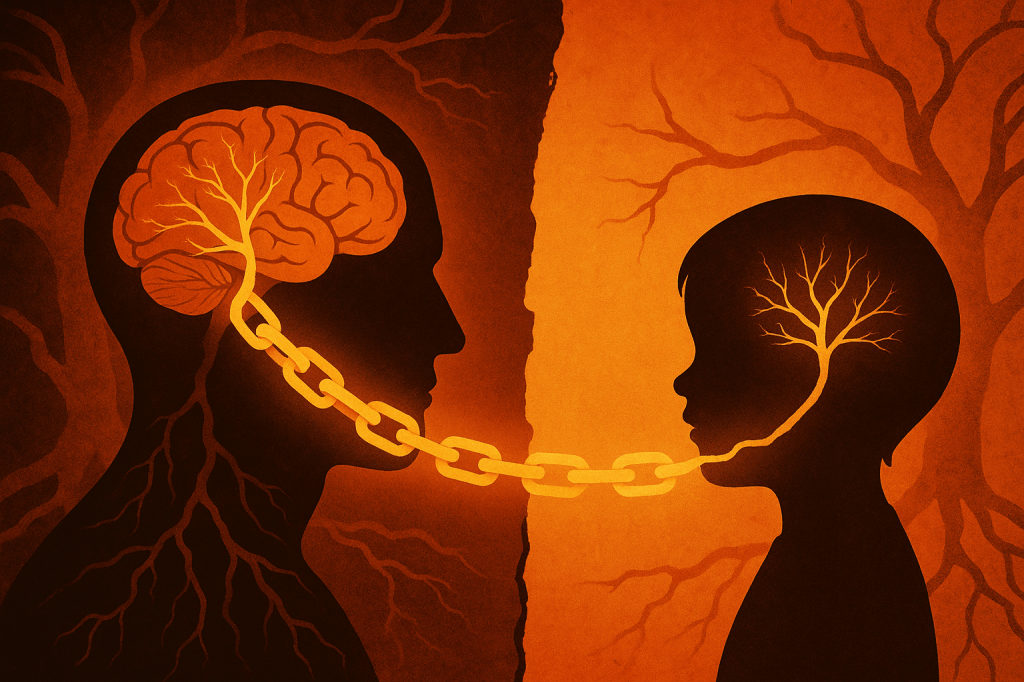
Living is a constant state of development. The choices we make curate our neurological individuality.
Have you ever wondered why you are stuck within a generational curse, forced to experience persistent struggles and patterns that have haunted your family across decades? While often shrugged off as superstition, modern neuroscience has started to unveil possible explanations and solutions to such repetitions. Far from the mystical work of a curse, these inherited challenges are starting to be understood as tangible products that are shaped from environment, experience and our willingness to change.
Groundbreaking studies from the 1960s at the University of California found that rats living in large, varied spaces were better at learning and exploring compared to the ones raised in standardised cages. Notably, the differences in their experiences affected cell growth within the brain, meaning they had distinct neurological differences. For instance, when studying their brains, these researchers found that the non-exploratory mice had lower acetylcholine levels, a neurotransmitter which supports cognitive efficiency within the hippocampus (memory), and cerebral cortex (thought and perception). More interestingly, these researchers studied the offspring of the caged mice and found them to contain even less acetylcholine, suggesting experience alters brain chemistry across generations. Moreover, these kin had a considerably thicker cerebral cortex, suggesting environmental deprivation not only affects current neurotransmitter levels, but may lead to abnormal brain development across generations.
This phenomenon isn’t limited to rodents with human studies showing similar patterns. For example, children born to mothers who experienced depression pre-conception are at risk of not only developing it as they age, but are at increased risk of challenges within their cognitive and social-emotional development. Similarly, this is seen with addiction and substance abuse, with future generations experiencing such risks through altered gene expression in the mother.
But the story doesn’t stop with inherited disadvantages. Our brain has the remarkable capability to adapt in its structure based on the tasks it has been set. For example, London taxi drivers must memorise all the streets in the city and be able to navigate them perfectly without help. As a result, they develop a significantly larger hippocampus than the average. Even when compared to London bus drivers, who have to know the streets but follow a fixed route, the taxi drivers have a far larger posterior hippocampi, demonstrating how demand alters supply.
As a result of these conclusions, research into learned helplessness becomes important. Such studies are quite unsettling to read, but they help us understand the importance of internal change. For instance, when a rat is tortured and pretended to be set free, once real escape is possible, it often does not try. In other words, the rat has learned that their previous actions have no effect, so puts in no further effort out of expected failure. In fact, rats which previously experienced inescapable periods, and who normally can swim for a few days would often fail and drown within minutes when dropped into a tank. Crucially, while this action of their drowning occurs, they simultaneously release acetylcholine, the same neurotransmitter previously mentioned, and which is only secreted during helpless scenarios.
For most reading this, its an expected conclusion. We learn behaviour, so therefore act upon our environment. However, the vital finding from these horrific studies is the simultaneous release of acetylcholine during death. As a result, these studies not only shows a deep behavioural change within the rat, but a whole shift in its neurological mechanisms. Such a foundational concept suggests that people who experience depression, anxiety and chronic stress may have neurological differences after such experiences. Especially since acetylcholine is only released during helplessness, it implies that people who experience preventable mental health conditions would highly benefit from resilience training alongside supportive environments and successful escape.
However, your epigenetic curse doesn’t have to be a permanent genetic mutations. Taking rodent studies again, early-life maltreatment caused a DNA change and neurological gene expression. However, putting the rats into a highly enriched environment post-treatment increased hippocampal and cerebral cortex efficiency, restoring learning and memory.
Unfortunately, human studies are limited but some have suggested that direct interventions like physical activity and local support networks influence epigenetic markers related to mental health disorders.
Overall, while you may live within a generational cycle of mental health disorders, this research tells us it is never too late. Whether you are intending on having children, or the child of a cursed family, making the correct steps to overcome genetic expression is a vital part of breaking it. Ensuring you improve your cognitive, memory and emotional capability could enable your epigenetics to overcome unavoidable, inherited obstacles.
Breaking generational cycles is not just possible, it’s a testament to the brain’s capacity for change. Current scientific understanding shows that with the right environment and mindset, we can rewrite our neurological inheritance for ourselves and future generations.
 Vitality Blueprint
Leave a comment