To have a cure, evil must be the primary driver of suffering, not an expression of systemic imbalance. Cancer is not the root of such evil, but rather a symptom of a dysfunctional habitat.
For this reason, we may never find a cure for cancer.
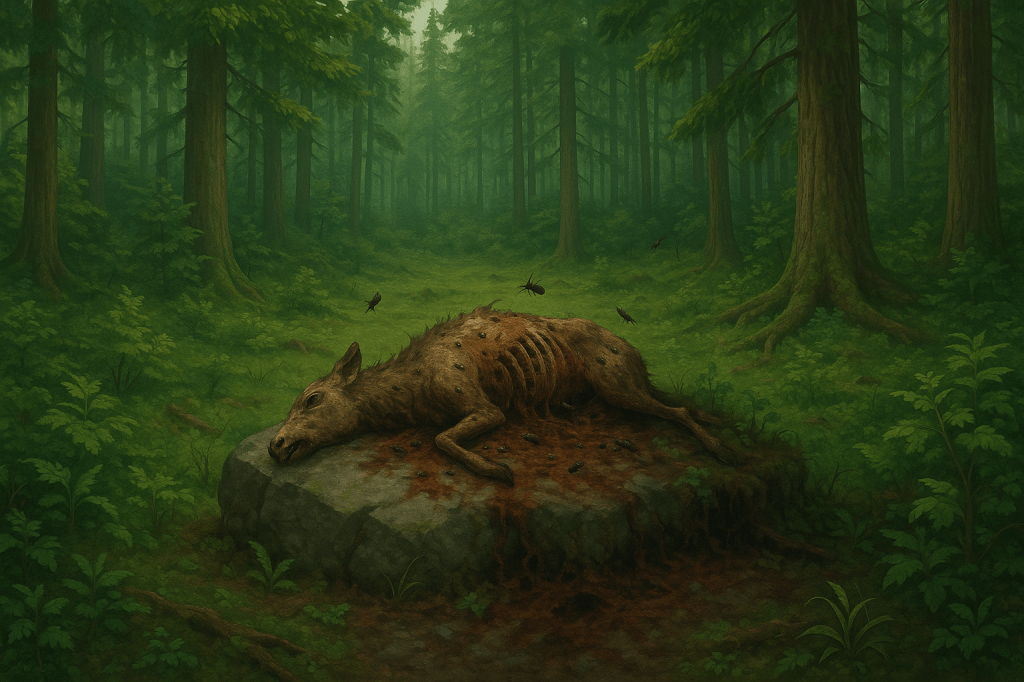
Imagine the greenest forest possible, teeming with wildlife alongside trees stretching from corner to corner. But, just like every environment, it moves through the circle of life. Each species of animal, from rabbit to wolf, lives, breathes, reproduces, and dies. As these animals pass, their corpses decompose into the soil, recycling their nutrients and enriching the local area. But, unfortunately for one of our forest inhabitants, its life ended on top of a large rock formation. As there is no soil underneath, its recycling process becomes blocked, leaving the remains to rot.
This rotting corpse, trapped and unable to return its nutrients to the earth, becomes a problem for our forest. Due to its abundance of energy, pests have been attracted. This disruption to the harmony of the surrounding soil has created a patch of decay where plant life can no longer grow and diseases thrive.
This much is clear. It is not the dead animal that has harmed the forest, but the environment where it died.
But what if the rock had never been there?
What if, over centuries, the rain had worn it down, the soil had covered it, or the roots of nearby trees had slowly broken it apart? What if the forest had been allowed to soften its harder places so that all fallen could return their life to the soil? Perhaps then, this animal would have decomposed like the others, with its body slowly regenerating the life around it. No pests, no disruption, no rot, and no disease. Just a pure end to its life cycle.
But not all forests are allowed to soften.
Instead, some grow rigid over time. Their soils erode, their roots weaken, and the rock formations expand. And so, when a life cycle ends, there is nowhere for it to return. The cycle halts. What should have been processed is left unrenewed. And in time, rot begins.
This is cancer.
Similarly to our forest, the human body runs like an ecosystem. Without adequate rain, sun, and fertile soil, the cycle of renewal halts. In our case, these elements take the form of low inflammation, adequate oxygen, balanced hormones, and proper nourishment. These satisfy the local terrain, allowing what needs to be recycled to be recycled, and what dies, dies.
But when the rain stops, or the soil becomes infected, the ecosystem starts to degenerate. But not with stone, but with scar tissue, calcification, and cellular confusion. Repair slows. Waste lingers. Dead cells are no longer removed. And just like our once perfectly ripe forest, the carcass remains, not out of rebellion, but because the terrain no longer knows what to do with it.
Cancer is not a sudden trespasser. It is a symptom of a body that has forgotten how to recycle itself. And just as in the forest, it is not the stone that started the decay. It is the rock that prevented the return.
In seeking a cure for cancer, perhaps we should look past eradicating the symptom and instead focus on restoring balance to the ecosystem. Just as the forest thrives when its cycle is unbroken and its terrain remains whole, so does the human body. Therefore, the path to health may not be in a ferocious war against a singular foe, but in nurturing conditions that permit our cycle to remain whole.
 Vitality Blueprint
Leave a comment