
From the Vietnam War to the first cinema showing of Star Wars, the 1970s truly had it all. Life in this era revolved around suburban homes, wood-panelled walls, and a new “free-range” parenting style that allowed children to explore their neighbourhoods freely and safely. Traditional gender roles were also shifting, as women entered the workforce en masse, permanently altering family dynamics. Fashion reflected this shift, with people adorned head-to-toe in bright colours and obscure patterns, embodied in wide-collared shirts, bell-bottom jeans, and the scent of over-individuality. Television was a central part of home life, with families gathered around a polyester sofa, watching Charlie’s Angels while waiting for the ping of their steaming microwavable dinners to signal that they were ready.
However, beneath the vibrant surface, a more troubling trend began to emerge as convenience took centre stage in daily life. The fast-paced lifestyle of the 1970s was marked by the rise of fast food, which transformed American eating habits. Not only did giant chains like McDonald’s and Burger King expand, but nutritional priorities shifted from value to speed. As families embraced the convenience of drive-thrus, frozen dinners, and five-minute meals, reliance on corporate consumption grew, setting the stage for the public health crisis we face today.
Convenience became a defining characteristic of the decade. Fast fashion emerged, allowing consumers to indulge their reward systems for meagre prices. Simplified home appliances revolutionised meal preparation, replacing traditional cooking with quick, often unrecognisable dishes. Instant entertainment flourished as cable television made it easy to consume media without ever leaving the home. Transportation options expanded with the rise of car culture, further fostering a dependency on automobiles.
This relentless pursuit of convenience did not come without consequences. The health impacts of these changes have become increasingly evidence over the decades, leading to alarming figures across the board:
- Previously, 15% of Americans were classified as obese; as of 2024, this figure has risen to nearly 50%.
- The prevalence of obesity among children has increased significantly, with 20% now classified as obese, up from just 5%.
- Only 23% of adults currently meet the recommended physical activity guidelines, a decline from approximately 50%.
- The proportion of individuals dining at fast-food restaurants on a weekly basis has risen to 37%, compared to only 10% in the past.
- The rate of depression has doubled since the 1970s.
- The incidence of diabetes has quadrupled over recent decades.
- Heart disease has emerged as the leading cause of death
- Approximately 66% of the population is currently on prescription medication.
- The use of selective serotonin reuptake inhibitors (SSRIs) has increased by about 1300%.
- Today, 60% of daily caloric intake is derived from processed foods, a substantial increase from 30%.
Before the calories in, calories out brigade comes barging in, it’s worth noting that the amount of energy an American consumes daily is not much higher than it was 50 years ago. This means that diseases, the prevalence of obesity, and mental health conditions cannot be entirely attributed to caloric intake; there must be other factors contributing to this crisis.
As the prevalence of obesity and heart disease surged, one of the significant shifts during the 1970s was the major adoption of seed oils into everyday foods. Currently labelled as “heart-healthy” by the American Heart Association (AHA), processed food and fast-food companies discovered the ability to use cheap and abundant industrial by-products in their food. McDonald’s and Burger King switched from beef tallow to vegetable oil, KFC moved to soybean oil, and Nestlé, Kraft Heinz, PepsiCo, and General Mills all transitioned to similar cost-effective oils.
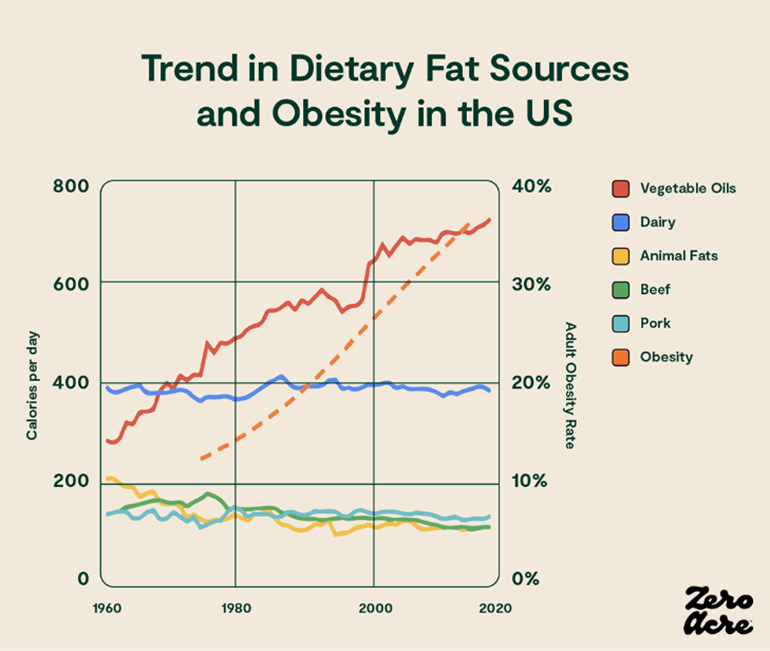
Today, the following seed oils are among the most used in the United States:
- Soybean Oil
- Canola Oil (Rapeseed Oil)
- Corn Oil
- Sunflower Oil
- Cottonseed Oil
- Safflower Oil
- Grapeseed Oil
- Sesame Oil
Despite the AHA claiming these hydrogenated oils to be “heart healthy,” the unbiased scientific consensus—devoid of conflicted interests—says otherwise. The mechanism to blame is called Obesogenic Toxic 4-Hydroxynonenal (HNE). Essentially, this is the reaction that occurs when vegetable oil is broken down in the body.
Linoleic acid, the essential polyunsaturated fatty acid belonging to the omega-6 family, breaks down into various molecules within the body, one of which is the aldehyde HNE. HNE is a toxin within the body, affecting our metabolic cycle, damaging fat cells, and resulting in the increased storage of fatty acids in these cells. Unlike other molecules related to linoleic acid, HNE is classified as “highly toxic” and is associated with Alzheimer’s, cardiovascular disease, diabetes, and liver disease.
While current dietary recommendations (which are not much to go off) suggest that the recommended intake of omega-6 should be about 5-10% of daily calories (again written by the AHA), the reality is that many exceed these amounts. For the average adult consuming 2,000 calories, this would amount to between 10-22 grams of linoleic acid daily, which people do not exceed unless controlling for vegetable oils, the culprit of heart disease.
However, it doesn’t stop there. Many foods regarded as “healthy” contain linoleic acid (such as flaxseeds, walnuts, and even chicken breast). The issues stemming from 4-Hydroxynonenal arise during the refining and heating processes these oils undergo.
During the refining stage, seed oils are subjected to deodorisation, bleaching, and neutralisation, which alters their chemical composition. Due to their high polyunsaturated fatty acid content, these oils become unstable when exposed to high heat. Consequently, when they undergo the heating process during formulation, they oxidise, structurally changing to include free radicals in the lipid structure. These free radicals essentially steal electrons from your cells, proteins, and DNA, leading to oxidative stress, metabolic dysfunction, and significant inflammatory responses.
If you don’t believe how big of an issue this is, here is a list of the most common foods that contain heated, free radical-containing seed oils:
- Fried foods
- Commercial salad dressing
- Processed snacks
- Commercial baked goods
- Margarine and spreads (excluding butter)
- Cereals and granola bars
- Pre-packaged/microwave meals
- Condiments
- Plant-based meat substitutes
- Energy/protein bars
- Frozen products
- Instant noodles
- and many more
It has become such a huge issue, that there is now a market for seed-oil-free supermarket products which is being driven by health-conscious consumers who are becoming aware of the health risks associated with these hydrogenous oils. It is also why we are seeing such a viral trend of carnivore-type diets, where people eat as a caveman would. Also, it explains why individuals like Robert F Kennedy Jr. and Casey Means have skyrocketed in popularity.
These shifts in consumer awareness reflect the growing dissatisfaction with conventional dietary recommendations and the increased desire for transparency. I, like you, would like to know why our heart foundations, the very organisations that are supposed to fight heart disease, are recommending cardiovascular disease-causing substances. If you are slightly interested in how this all started, read Ancel Keys’ Seven Countries Study where he found a correlation between saturated fat and heart disease. Take a look into how many organisations reference this research that completely ignores lifestyle, genetics, and other aspects of nutrition. Try to find out where the funding for this widely referenced research comes from, because the likelihood is, that you won’t be able to find it.
But anyway, that’s for a completely different article.
My recommendation? Eat single-ingredient foods. These contain the non-harmful, essential polyunsaturated fatty acid, but do not have any hydrogenous oils. But, if you were to eat processed food, try to find the ones with the smallest percentage of seed oils, or find ones with none at all. Your heart will thank you for it.
 Vitality Blueprint
Leave a reply to Everyone Should Eat Coconut Oil – Mark's Newsletter Cancel reply