
As the crisp Autumn wind sweeps through the towering pines of the vast Alaskan wilderness, a lone 650-pound grizzly bear treads through the rustling underbrush. With each step, its great brown paws crunch fallen leaves, marking the ground with detailed prints. The air carries a sharp, but light chill, hinting that snow is on its way. Rivers foam to the mouth with salmon fighting against its current, each one a prize the bear snatches with effortless power. Nearby, berry bushes seep under the weight of their ripened fruit, whilst pinecones litter the ground for all eyes to see. Nature’s buffet truly had been laid bare.
Day-after-day, the bear gorges, putting on fat like there is no tomorrow. But, as the first snowflake drops, it retreats to a hidden den, lying in its own embrace. Heartbeats start to soften, breaths depress and months slip by in silence. No hunger, no thirst, no urination, just quiet survival. Come spring’s light, the bear emerges, sleek and strong, ready to reclaim its home.
But, beneath the tale of nature’s resilience lies an important lesson for us…
Around the Western world, people are consuming polyunsaturated fatty acids, also known as PUFAs, at an extremely alarming rate. Between the years of 1909 to 2010, per capita consumption of PUFA has increased 238% going from 13 grams a day to a whopping 44 grams. Wait a second. By using the word “alarming” am I suggesting that eating these essential fatty acids is an unhealthy choice? Am I implying that the fats your doctor and health professionals have been encouraging you to eat, are actually damaging to your health? Simply put, yes. The exact foods you have been told to eat for the past few decades are not only detrimental to your metabolic health, but are one of the culprits to the steep rise in obesity rates.
Unfortunately, most people who consume PUFAs think they are doing something beneficial to their health, or at least something not disadvantageous. Are you filling your dietary habits with seeds, nuts, fatty fish and, the worst, vegetable oils? If so, then you are unknowingly contributing to the metabolic disaster unfolding around you. Big claim, I know. But hear me out.
So what actually is a polyunsaturated fatty acid? And why do I suggest we should stop consuming it?
Essentially, a PUFA is a subclass of fatty acids that has two or more carbon-carbon double bonds in its chemical structure, meaning this fatty acid has a reduced number of hydrogen atoms compared to its saturated counterpart. This means that with each double bond the hydrogen count reduces by two, replacing it with C=C connection. Having carbons next to the double bond, like with PUFAs, makes the remaining C-H bond weaker, and more susceptible to oxidation
Since PUFAs are fatty acids with at least two carbon-carbon double bonds, which results in fewer hydrogen atoms overall compared to its saturated counterpart. This setup creates “allylic” spots, meaning carbon atoms right next to the double bond, thus creating a weak spot that is prone to oxidation.
A whole lot of gibberish, I know, but stay with me.
Take a look at the image below for more clarity. The double bonds I mentioned above are those double lines on the PUFA and MUFA molecules, and it is these parts that are prone to oxidation. But why does it do this? This double bond acts like a magnet to nearby hydrogen-stealing oxygen atoms, taking a piece out of the fatty acid puzzle. Once that hydrogen has been grabbed, it creates an unstable “radical” spot, forming damaging compounds that spread to other molecules like falling dominos.
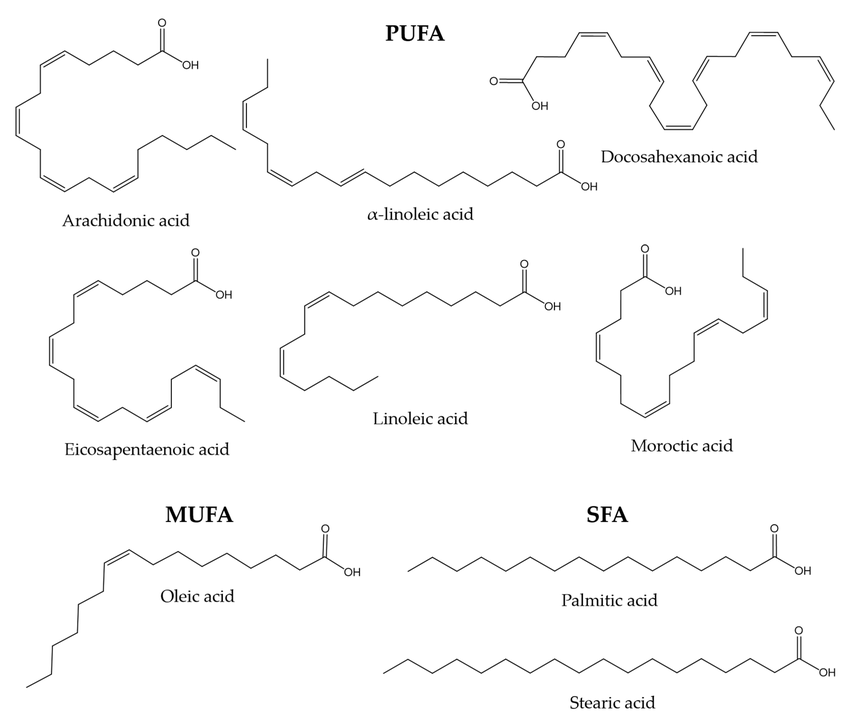
So does this mean that by eating something containing PUFAs we are encouraging a damaging process to occur within the body? Not exactly. See, oxidation is a natural part of the body’s energy production system, but too much is when issues start to occur. Best described as rust forming on metal, the process of hydrogen theft encourages inflammation and metabolic issues within the human body. But, naturally, your body enables some oxidation to fight off germs or to make energy, but too much is called oxidative stress, and occurs when the number of free radicals outnumber antioxidants.
Free radicals, like those just discussed from PUFA consumption, steal electrons from healthy cell components like its fats (cell membrane), proteins (enzymes) and DNA (genetic material) to try and stabilise themselves. The theft of these electrons acts as a procreation system for free radicals, enabling a chain reaction to take place. Essentially, a free radical grabs a hydrogen atom from a fatty acid molecule, which is easier to do when not saturated, turning the fat itself into a free radical. This new fat radical reacts with oxygen, forming an unstable compound called peroxides that then steal hydrogen from other nearby fats spreading the damage like dominos. As a result of all this, cell membranes become weaker, having their function disrupted and enabling toxic byproducts to build up, protein signalling impairs, and DNA is broken apart.
However, a body-wide inflammatory response is not the only issue from these free radicals. As we have all heard, the mitochondria is the powerhouse of the cell. But what does that actually mean? Most importantly, this organelle generates energy through ATP production. Basically, it governs how efficiently we turn food into energy. But, as we now know, free radicals are electron stealing particles, meaning our mitochondria cannot sufficiently create energy, leading to a reduced metabolic rate and caloric expenditure. Yes, this means that having too many free radicals can hinder our fat loss progress.
And this is where we (finally) get back onto our bears.
Before winter, bears gorge on PUFA-rich foods like salmon, nuts, seeds and berries. After their long sleep, they shift their eating habits to saturated fatty acid rich foods which help remodel their adipose tissue. By shifting their storage from PUFA to SFA they support a higher energy demand for activity, rebuilding muscle and reproduction. Since SFA are denser with longer-lasting energy (even with the same calories), these are a spring bear’s best friend.
Like humans, bears retain PUFAs in membranes and white adipose tissue to enhance their torpor expression. This allows their body temperature to reduce, slow their heart and suppress metabolic function for longer periods without the need to eat, drink or even urinate. But, unlike humans, a grizzly bear has an extremely efficient antioxidant system coming up to hibernation. Grizzlies are built for this. Their hibernation is a controlled, seasonal state with genetic and hormonal protections to stop the potential side effects of a high PUFA diet. Humans, however, are an inferior species that lack any such protections. This means that when we consume a diet like a bear, we do not become as big and scary as one, instead it does the opposite. We become weak, frail and filled with metabolic dysfunction.
Whilst being essential, as in, the body cannot produce it on its own, we require them to come from diet. Without any PUFAs, our cells are not as fluid and flexible. But, of all the polyunsaturated fatty acids that exist, all but two can be made in complete abundance from saturated fatty acids. This means there are only two we need to get from diet, and those are linoleic acid and alpha-linoleic acid, both of which can be found in pasture raised chicken and eggs (try your best to avoid industrially farmed). However, the need for these two acids (at least at the level of current recommendation) is under lots of scrutiny at the moment.
The only way you can overcome a high oxidative stress diet is to eat equally high in antioxidants. As the names suggest, these molecules help protect cells by neutralising free radicals. Essentially, they give back the electrons that were stolen, preventing the chain from furthering and returning compounds like fatty acids back to their original form. Examples of (beneficial) foods that are high in antioxidants are oranges, watermelons, and berries (the first two are preferred), but you can also go for herbs like mint and oregano. Though having lower antioxidants levels, shellfish like shrimp, lobster, oysters and mussels contain carotenoids, selenium, zinc, copper vitamin E, and bioactive peptides, which are also anti oxidation compounds.
Finally, Saturated fat is not your enemy. In fact, it is your friend. I know this can be a complete mind altering concept given the anti-saturated propaganda that has been forced down your throat. So, for more information, I recommend taking a look into this article.
So please, for your own health. Don’t eat like a bear, eat like a human.
Foods Highest in Polyunsaturated Fatty Acids (PUFAs)
| Food | Total PUFA (g) per 100g | Total PUFA (g) per 100 Calories |
|---|---|---|
| Hemp Seeds | 78.00 | 14.10 |
| Safflower Oil | 74.92 | 8.48 |
| Sunflower Oil | 65.71 | 7.43 |
| Soybean Oil | 58.96 | 6.67 |
| Corn Oil | 55.79 | 6.31 |
| Flaxseed Oil | 53.37 | 6.04 |
| Walnuts | 47.17 | 7.21 |
| Canola Oil | 30.42 | 3.44 |
| Flax Seeds | 28.72 | 5.38 |
| Fish Roe (mixed species) | 25.00 | 11.36 |
| Chia Seeds | 23.62 | 4.86 |
| Sunflower Seeds | 23.12 | 3.96 |
| Pecans | 21.62 | 3.13 |
| Soybeans (dry roasted) | 15.00 | 3.36 |
| Pistachios | 13.45 | 2.40 |
| Almonds | 12.07 | 2.08 |
| Olive Oil | 11.85 | 1.34 |
| Palm Oil | 10.34 | 1.17 |
| Tofu | 10.00 | 13.16 |
| Mackerel (cooked) | 4.58 | 1.50 |
| Salmon (farmed Atlantic, cooked) | 2.32 | 1.13 |
| Sardines (canned in oil) | 2.21 | 1.06 |
| Herring (cooked) | 2.01 | 0.86 |

 Vitality Blueprint
Leave a reply to Danny Wang Cancel reply